
Modern
Analytics
for Everyone
Billions of data points. Automated data cleaning. Intuitive user interfaces.
Featuring Q-Sensei's intelligent indexing technology
so that everyone gets real-time access to data,
can monitor KPIs, and connect the dots.


Modern
Analytics
for Everyone
Billions of data points. Automated data cleaning. Intuitive user interfaces.
Featuring Q-Sensei's intelligent indexing technology
so that everyone gets real-time access to data,
can monitor KPIs, and connect the dots.
Modern
Analytics
for everyone
Billions of data points. Automated data cleaning. Intuitive user interfaces. Featuring Q-Sensei's intelligent indexing technology so that everyone gets real-time access to data, can analyze KPIs and connect the dots.

Who is
Q-Sensei?
We are here to build the most powerful, yet easy to use products to query, visualize and deliver insights from streaming and historic data. We make it easy to ingest, analyze, modify and model data.

Who is
Q-Sensei?
We are here to build the most powerful, yet easy to use products to query, visualize and deliver insights from streaming and historic data. We make it easy to ingest, analyze, modify and model data.
Hyper-precise Querying

Hyper-precise Querying
We offer the only Query Builder that provides analysis and suggestions as you build your query. Dive deeply into outlier data points and underlying event data. Fully compatible with existing tools.

The Q-Sensei
Platform
Our platform is a powerful catalyst for data-intensive Analytics applications.
Unique in processing multi-dimensional data quickly and efficiently, you can boost your
Machine Learning pipelines and bring Data Analysis to a whole new level.
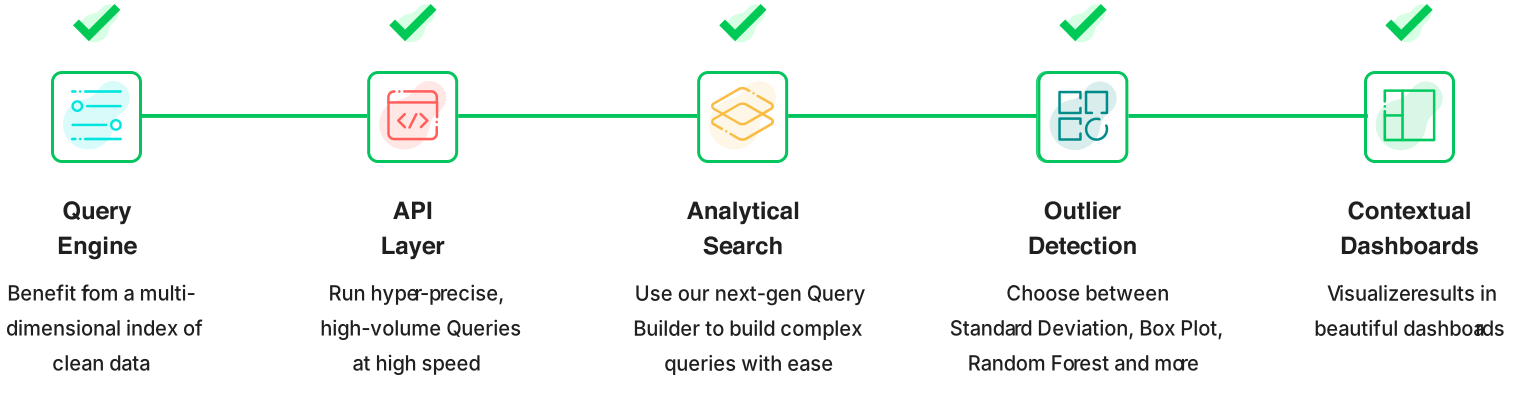
The Q-Sensei
Platform
Our platform is a powerful catalyst for data-intensive Analytics applications. Unique in processing multi-dimensional data quickly and efficiently, you can boost your Machine Learning pipelines and bring Data Analysis to a whole new level.
Need a custom solution to advance analysis of your data?

Q-Sensei adds Value to Data
We efficiently convert all data into clean Facets so you can identify elements, expose relationships, and derive fresh insights. Data becomes better accessible and useful, once it is faceted.
Q-Sensei adds Value to your Data
We efficiently convert all data into clean Facets so you can identify elements, expose relationships, and derive fresh insights. Data becomes better accessible and useful, once it is faceted.

For truly Interactive Data Analysis and powerful Machine Learning projects, your team needs access to all data - well-organized and clean. We advance analytics, predictions and automation with hyper-precise, high-volume, and high-speed querying.
10,000+
You can query and analyze thousands of facets. There is literally no limit for granular analysis and cross-correlation of data.
1,000x
Use our Boost-service and be up to 1,000x faster in faceted statistical analysis. Benefit from our new way of algorithmic querying.
450%
We have tested Query-Result-Relevancy and found that Q-Sensei users achieve up to 450% higher accuracy in their results.
For truly Interactive Data Analysis and powerful Machine Learning projects, your team needs acccess to all data - well-organized and clean. We advance analytics, predictions and automation with hyper-precise, high-volume, and high-speed querying.
10,000+
You can query and analyze thousands of facets. There is literally no limit for granular analysis and cross-correlation of data.
1,000x
Use our Boost-service and be up to 1,000x faster in faceted statistical analysis. Benefit from the new way of algorithmic querying.
450%
We have tested Query-Result-Relevancy and found that Q-Sensei users achieve up to 450% higher accuracy in their results.
Get started
today!
Start your free trial today or contact us, if you'd like to discuss
other use cases or needs for high-speed, multi-dimensional querying.
Get started
today!
Start your free trial today or contact us, if you'd like to discuss other use cases or needs for high-speed, multi-dimensional querying.


