Q-Sensei

About Q-Sensei

Q-Sensei translates cutting-edge research into practical technology, turning complex information into actionable intelligence.

Mission

Our mission is to enable humans, AI, and autonomous systems to work with information more effectively — deepening understanding, uncovering new possibilities, and enabling better-informed action with confidence.

Preserving context to improve reasoning

The conventional approach

Traditional systems are often built around simplifying information to make it easier to store, process, and analyze. Data is filtered, aggregated, separated, or reduced to fit the limitations of the technology. While this can make information more manageable, it can also remove relationships and context that give it meaning.

When AI works with incomplete or disconnected information, critical context is lost, making it harder to distinguish what matters from what does not and increasing the risk of inaccurate or hallucinated results.

The Q-Sensei approach

Q-Sensei is built on the principle of keeping information connected. Rather than reducing complex information into simplified representations, its technology preserves dimensions, relationships, and context while making them accessible at scale.

This gives people and AI a more complete view of the information they work with. They can explore it from different perspectives, uncover connections and patterns, and develop deeper insights with greater precision and confidence.

The people behind the technology

Q-Sensei grew from a shared conviction among researchers, technologists, and entrepreneurs: complex information should not be simplified just so technology can handle it. The challenge was to make it accessible while preserving the connections, dimensions, and context that give it meaning.

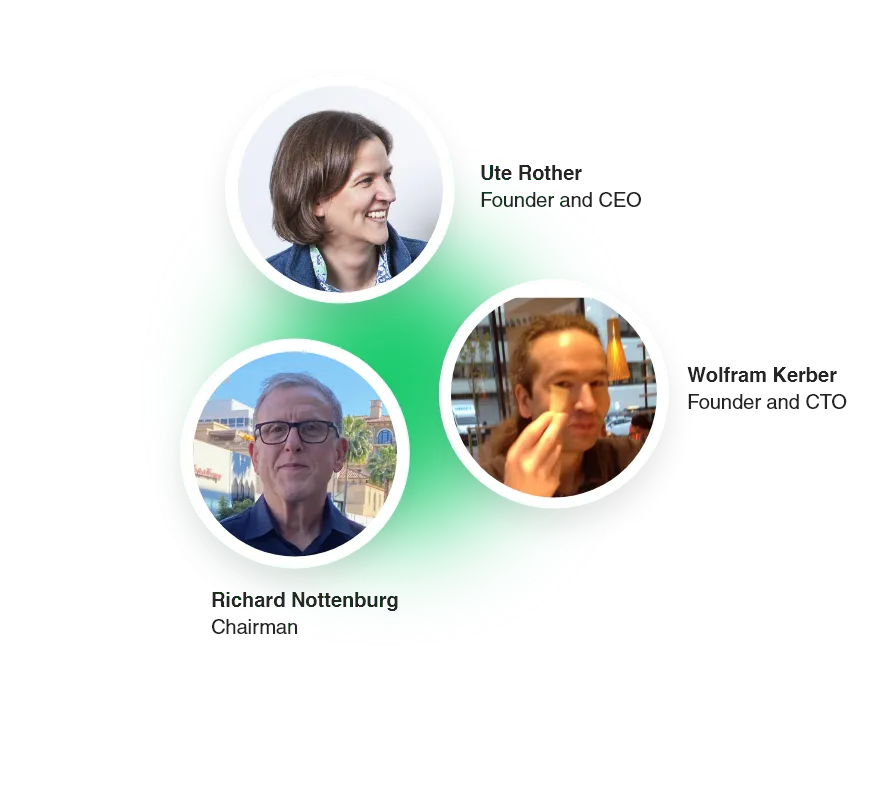
Among those who shaped the company’s early development were Ute Rother and Wolfram Kerber, whose experience in data, software, and information technology helped establish Q-Sensei. The company’s work also drew on patented research into multi-dimensional information search and presentation developed by Tim Poston, Raghu Raghavan, and their colleagues. These ideas continue to shape how Q-Sensei enables people to explore complex information.

Over the years, researchers, engineers, data specialists, customers, partners, and investors have contributed their expertise and perspectives — challenging ideas, refining the technology, and expanding what is possible. Today, Q-Sensei is driven by a focused team combining product and commercial leadership, deep technology expertise, and software development.

Ute Rother

Ute Rother

Co-Founder & CEO

Ute leads Q-Sensei’s strategic, product, and commercial direction, shaping the company’s vision and its approach to making advanced data analysis accessible beyond specialist users.

With a deep background in data analytics, she has played a central role in shaping Q-Sensei’s technology and product experience, enabling users to explore complex information and uncover relationships and patterns more effectively.

Her focus is on turning deep technology into products that create lasting value for customers and open new possibilities for how people work with information.

Wolfram Kerber

Wolfram Kerber

Co-Founder & CTO

Wolfram is a technology architect with more than three decades of experience in software and data engineering.

His career includes pioneering enterprise Python development before its widespread adoption and designing high-performance, in-memory processing frameworks well before technologies such as SAP HANA emerged.

At Q-Sensei, he leads the development of the AI Data Engine, driving its architecture and technical direction with a focus on algorithmic efficiency, high-performance processing, and advanced data algorithms.

Robert Jörg

Robert Jörg

SVP Product Engineering

Robert leads development of Q-Sensei’s software experience, translating the capabilities of the underlying AI Data Engine into an intuitive and responsive environment for data analysis and exploration.

His focus is on making complex information easier to navigate, analyze, and understand — giving business and analytical users a direct, highly interactive way to explore and work with their data.

Dr. Richard Nottenburg

Dr. Richard Nottenburg

Chairman

Richard has played an important role in Q-Sensei's development, helping guide the company as its ideas, technology, and ambitions have evolved.

Drawing on extensive experience in technology leadership and global innovation, Richard has contributed strategic perspective throughout Q-Sensei's development and continues to do so as the company advances its products and expands its commercial reach.

Investors

Q-Sensei’s development would not have been possible without the support of bm|t in Thuringia, Verizon Ventures, and a notable group of business angels.

Their belief in Q-Sensei, together with their investment, experience, and perspective, has played an important role in building the company and advancing its technology.

  • Verizon Ventures
  • bm-t

Where it can lead

The need to connect complex information extends across industries and organizations. Wherever valuable insight depends on information from different sources, disciplines, or perspectives, Q-Sensei provides a meaningful way to explore what that information reveals.

The examples below illustrate some of the possibilities. As the technology evolves and is applied to new domains, Q-Sensei can support new ways to understand, uncover relationships and patterns, and turn information into insight.

Climate science

Satellite observations, weather patterns, environmental measurements, and historical data can be combined to better understand ecosystems, identify emerging patterns, and anticipate risks.

Health

Clinical, genomic, imaging, and research data can be integrated to explore complex relationships, uncover emerging patterns, and support earlier discovery and more personalized care.

Government & public policy

Legislation, public data, economic indicators, demographic trends, and research can be linked to better understand complex issues, explore potential impacts, and support better-informed decisions.

Explore what is possible

Whether you are facing a complex information challenge, looking for new ways to uncover insight, or exploring what might be possible with a different approach, we would be pleased to hear from you.